
Hey everyone! Today, I’m sharing some eye-opening mail order bride statistics and a whole lot of real talk on international dating.
If you’ve ever wondered how to find a wife or how to find a mail order bride, stick around. I’m here to break down the numbers, share cool K-1 visa data, and give you practical tips on dating a foreign bride. Trust me, these insights can make all the difference in your search for that perfect foreign wife.
Why the mail order bride stats are messy
If you want a simple total like “X mail order brides per year,” you’ll be annoyed. There’s no neat counter. Most systems don’t track “how you met.” Marriage records usually don’t ask. Visa forms usually don’t care if you met on an app or at a cousin’s wedding.
Even when we do have data, definitions are all over the place. One source counts visas. Another counts marriages. Another counts website users. Another counts scam reports. Those don’t line up cleanly, and they can overlap. One couple can show up twice, and one couple might show up nowhere.
Then there’s the human part. A lot of people keep this private. Some are embarrassed. Some just don’t want attention. Scam victims often don’t report. Happy couples usually don’t report anything at all. So the numbers can skew hard toward the loud stuff, and quiet normal life stays invisible.
That’s why I treat stats like streetlights. They show you parts of the road. They do not show the whole road.
A quick mail order bride stat snapshot
Here are a few numbers I use to set the scene. None of them are a clean count of “mail order brides.” They’re more like road signs that show where paperwork and money show up.
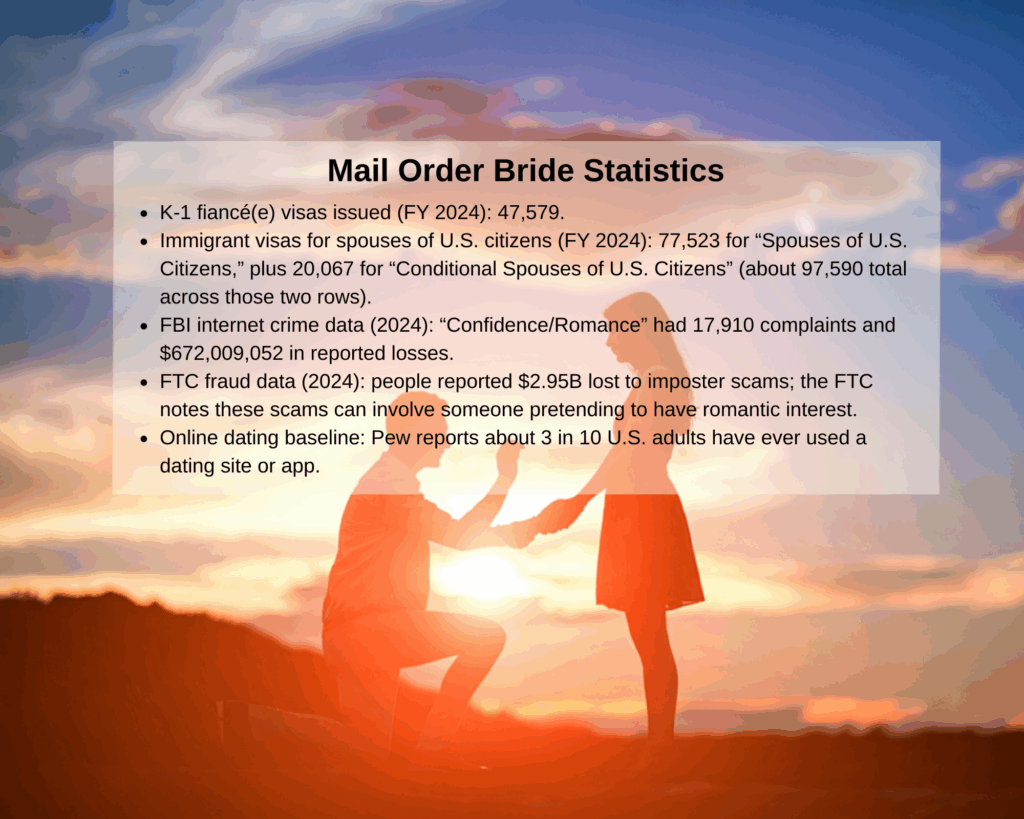
- K-1 fiancé(e) visas issued (FY 2024): 47,579.
- Immigrant visas for spouses of U.S. citizens (FY 2024): 77,523 for “Spouses of U.S. Citizens,” plus 20,067 for “Conditional Spouses of U.S. Citizens” (about 97,590 total across those two rows).
- FBI internet crime data (2024): “Confidence/Romance” had 17,910 complaints and $672,009,052 in reported losses.
- FTC fraud data (2024): people reported $2.95B lost to imposter scams; the FTC notes these scams can involve someone pretending to have romantic interest.
- Online dating baseline: Pew reports about 3 in 10 U.S. adults have ever used a dating site or app.
One small warning from me: these live in different buckets. Visa counts aren’t marriage counts, and scam reports aren’t “mail order” counts. They just overlap in real life.
Where the numbers come from
When I look for solid numbers, I start with sources that have a reason to count things accurately:
- Government visa reports (fiancé(e) routes, spouse routes, other family categories)
- Marriage registry data from countries that publish “foreign spouse” counts
- Big surveys about online dating use and relationship patterns
- Law enforcement and consumer complaint reports that track romance scams and fraud losses
- Academic studies that pull from census data, marriage records, interviews, or case reviews
I also pay attention to what I call “soft data,” like platform trend posts or industry reports. Those can be useful, but I don’t treat them like fact unless they show how they counted and what they left out.
My basic rule is simple: I trust a number more when the source explains the method, defines the terms, and shows the same kind of count year after year. If a site screams “90% success rate” with no details, I toss it in the trash.
More international dating statistics that matter – what to know?
Online dating has changed how people meet across borders. Business of Apps puts global dating app revenue at about $6.18 billion in 2024. Wider market studies say the whole online dating industry is around $10 billion now, and worldwide app users are now in the 350–400 million range.
Statista’s market data shows how this breaks down by country. In the United States, about 60.5 million people used dating apps in 2024. Research on how couples meet, shared by Statista from Rosenfeld’s work, shows that the share of heterosexual couples in the US who met online jumped from 2% in 1995 to 39% by 2017. Pew Research Center adds that about 30% of American adults have tried online dating, and around one in ten partnered adults met their current partner on a site or app.
Cross-border love fits into a larger movement of people. According to UN DESA, there were about 304 million international migrants in 2024, almost half of them women. Eurostat found that about one in twelve married people in the EU is in a “mixed marriage” with a spouse born in another country. A US Census Bureau report says 21% of married-couple households in the US include at least one foreign-born spouse. These numbers match stories from Asia too, where official Korean stats show a clear rise in marriages with foreign spouses in recent years.
Surveys also show that many people on these sites want something serious. Pew’s 2023 online dating study reports that about one-third to almost half of singles say a long-term relationship is their main goal, not casual dates only. This helps explain why international dating platforms and “mail-order bride” style services keep growing inside the wider online dating scene.
K-1 visa data by country: A closer look
One of the most interesting aspects of international dating is the K-1 visa—a visa that lets an American bring their fiancée to the U.S. Below is a table with approximate K-1 visa counts by country in 2023-2025. This data gives you a peek into the mail order bride statistics and shows where many foreign brides and wives come from.
| Country | Approx. K-1 Visa Count | Notable Insight |
| Japan | 316 | Many men seek a Japanese bride, drawn by her grace and rich cultural heritage. |
| China | 365 | A growing number of Chinese brides are looking for serious relationships with American partners. |
| Thailand | 436 | The appeal of a Thai mail order bride lies in her vibrant personality and unique cultural charm. |
| Ukraine | 202 | Each Ukrainian mail order bride is highly sought after for their beauty and strong family values. |
| Russia | 17 | A Russian mail order bride remains a popular choice among U.S. men. |
| Poland | 150 | Every Polish mail order bride is known for their mix of traditional values and modern outlook. |
| Brazil | 650 | A Brazilian mail order bride brings warmth and energy, adding a lively flavor to international dating. |
| Dominican Republic | 965 | A smaller yet significant group, a Dominican mail order bride offers a friendly and vibrant cultural touch. |
| Mexico | 2,028 | Many men turn to Mexican mail order brides for their rich cultural background and heartfelt traditions. |
| Philippines | 2,905 | Filipina bride is celebrated for her nurturing nature and commitment to family values. |
This table tells a story. You can see many women come from Eastern Europe, Asia, and Latin America. These figures show a part of the mail order bride statistics and give you a window into how many foreign women want to date American men. If you’re curious about which regions have a soft spot for U.S. charm, check out countries that love American men.
A wider look at mail order brides outside the U.S.
Outside the U.S., this topic gets messy fast because countries track different things: marriages registered, resident status, citizenship, visa class, or some mix. So I like to show a few real examples.
South Korea: “marriages of immigrants” as a headline stat
Statistics Korea reports 21,450 marriages of immigrants in 2024, up 5.0% from 2023, and says these marriages were 9.6% of total marriages. It also breaks out types, with “Korean husbands and foreign wives” at 71.2%. This is close to what many people mean by “international marriage,” but notice how it’s defined and grouped.
The EU: big totals, plus lots of country-by-country rules
Eurostat reports about 1.8 million marriages in the EU in 2023 and also publishes marriage stats in multiple ways across member states. That’s helpful for scale, but “international marriage” can still vary by how each country records citizenship, birth country, and residence.
England and Wales: marriages + civil partnerships in the same count
ONS reports 231,949 marriages and civil partnerships in 2023 (provisional). This is a good reminder that even the base “how many couples made it legal” number can mix categories that other countries separate.
Taiwan: a “stock” measure, not a yearly marriage count
Taiwan’s government open data platform lists a dataset for the number of foreign spouses and mainland spouses by region and gender. That’s not “marriages this year.” It’s closer to “how many people have this spouse status on record,” which answers a different question.

How people actually meet now
If you picture “mail order bride” as some special corner of the internet, the stats say it’s way more normal than that. Plenty of people start with the same tools everyone else uses, then the match just happens to live far away.
Pew says three in ten U.S. adults have used a dating site or app. It also says 9% did so in the past year (survey fielded July 5–17, 2022). Pew also reports that 1 in 10 partnered adults met their current spouse or partner through a dating site or app. Younger folks stand out: 1 in 5 partnered adults under 30 say they met that way.
On the “how couples meet” side, Rosenfeld and coauthors (using a nationally representative U.S. survey) found that for heterosexual couples who met in 2017, about 39% met online. For same-sex couples who met in 2017, it’s about 65%. They also say meeting online became the most common way heterosexual couples meet, and it overtook meeting through friends around 2013.
My takeaway: “international” is often just a side effect of normal online dating. Filters, location settings, social media, travel photos, and time zones make it easier to start a relationship far away. The “how we met” story now sounds a lot like everyone else’s story.
Scams and safety, with real numbers
This is the part I never sugarcoat. The same tools that help real couples meet also help scammers find targets.
From the FBI’s IC3 2024 report: Confidence/Romance scams show 17,910 complaints and $672,009,052 in reported losses. Those are reports that made it into the system. The FBI also notes that many crimes go unreported in general, so real losses can be higher than any table shows.
FTC data tells a similar story from a different angle. In the FTC’s Consumer Sentinel Network Data Book 2024, “Imposter Scams” had 845,806 reports. 22% reported a dollar loss, and the total reported loss in that category was $2.95 billion. The FTC says that bucket includes people falsely claiming to be a romantic interest (among other roles).
So what does “safe” look like in real life?
- No money. Not for tickets, not for “fees,” not for “help,” not for crypto. Once money starts, the pressure usually ramps up. The FBI’s romance scam guidance is blunt about this pattern.
- Video calls early and often. If they dodge video, treat that as a big problem.
- Slow pace. Scammers push fast emotions, fast plans, fast secrets. The FBI warns about “moving quickly” and pushing for money, and the FTC warns about requests for money and personal info.
- Stay on-platform longer. A common play is “let’s move to WhatsApp/Telegram right now.” The FBI calls out pressure to leave the service as a warning sign.
If you think you got hit, report it. It helps investigators connect cases.
Wrapping it up: My final thoughts
International dating and mail order bride statistics are more than numbers. They tell the story of real people seeking love across borders. As a legal expert, I’ve seen firsthand how understanding these stats can help you make smarter, more informed choices when it comes to dating a foreign bride or foreign wife.
I hope these stats and tips give you the confidence to take that next step. Whether you dream of a Russian mail order bride, a Mexican mail order bride, or any other kind of foreign bride, the key is to be real, patient, and ready for the great ride that is love.
Cheers to finding your forever love across borders! Happy dating, and remember—your perfect match might just be a click away.
FAQ
Are “mail order brides” legal?
The label is old-school and kind of messy. What’s legal is two adults choosing to date, marry, and follow the law. In the U.S., some matchmaking businesses fall under IMBRA rules, and the government gives fiancé(e) and spouse visa applicants info about rights and safety.
What’s the difference between a K-1 fiancé(e) visa and a spouse visa?
K-1 is for couples who plan to marry after the foreign partner arrives in the U.S. A spouse visa is for couples who are already married, so the spouse enters on an immigrant visa path. The State Department has a basic overview of the K-1 category.
How many K-1 fiancé(e) visas get issued?
For FY2024, the U.S. issued 47,579 K-1 visas. FY2023 was 19,825. Big swings can happen due to backlogs and catch-up work, so I treat it like a trend clue, not a forever number.
How many spouse visas get issued?
In FY2024, the State Department’s report shows 77,523 visas under “Spouse of U.S. citizen” and 20,067 under “Spouse of U.S. citizen (conditional).” These are visas issued abroad, so it’s not every single marriage-based case in the whole system, but it’s still a solid baseline.
Do these marriages last?
There isn’t one clean global divorce stat for “international marriages formed online,” because countries track marriage and divorce in different ways, and most don’t tag “how you met.” What I trust more is this: outcomes tend to follow normal relationship stuff—honesty, money habits, family pressure, and how people act when life gets boring.
How common are romance scams in this space?
Too common. The FBI IC3 2024 report lists 17,910 Confidence/Romance complaints and about $672 million in reported losses. Even if only a slice of that is cross-border, it’s still enough that you should take scam checks seriously.
What rights and protections exist for foreign fiancé(e)s and spouses in the U.S.?
The U.S. government provides a rights-and-protections page for visa applicants, and there’s also an official pamphlet meant to help people understand safety and legal options. IMBRA is part of why this info is baked into the process.
What countries are most common for international marriages?
It depends on the country you’re asking about and the year. For a clear example outside the U.S., South Korea reported 21,000 marriages with foreign spouses in 2024. Most places don’t publish one neat table that covers everything, so I use official reports when they exist, and I avoid “top 10” lists that don’t show sources.